Safety first. Wear eye protection and gloves. Keep sparks, flames and cigarettes away: lead-acid batteries can release hydrogen gas. Disconnect the negative (-) terminal first and reconnect it last. Never work on hybrid or EV high-voltage batteries. Follow your owner’s manual.
A jump start gets you moving, but it does not tell you why the battery went flat. Follow it with the dead battery or alternator checker.
What you will need
- Jumper cables or a portable jump starter.
- A second car with a healthy 12V battery, if using cables.
- Gloves and eye protection.
Steps
-
Park the cars close but not touching, switch both off and apply the handbrake.
-
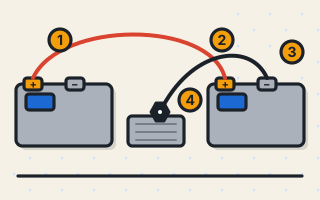
Connect red to the dead battery’s positive (+).
-
Connect the other red clamp to the good battery’s positive (+).
-
Connect black to the good battery’s negative (-).
-
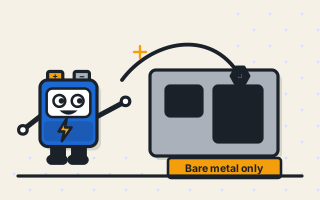
Connect the last black clamp to bare, unpainted metal on the dead car’s engine block, away from the battery.
-
Start the good car and let it run a few minutes, then start the dead car.
-
Remove the cables in the reverse order.
-
Drive for a while so the alternator recharges the battery.
Troubleshooting
- Only clicking: the connection may be poor. Check clamps and corrosion; see cleaning corrosion.
- Starts, then dies: suspect the charging system.
- Flat again next day: the battery may be failing. Check replacement cost and test it with a multimeter.
Do not jump-start a damaged, frozen or leaking battery. Check your owner’s manual first, especially on hybrids and EVs.
Why a car goes flat
The usual causes are an ageing battery, lights or accessories left on, short trips that never recharge it, extreme cold or heat, and a charging fault. A jump start fixes the symptom, but if the battery was already near the end of its life it will fail again. Check its age with the battery life estimator.
Jump-start with cables or with a portable starter?
A portable jump starter is a battery pack with clamps. It is simpler and safer because you do not need a second car, and many have reverse-polarity protection. Follow the maker’s instructions. Cables need a donor car with a healthy battery of the same system voltage. Never jump a 12V car from a higher-voltage source.
Extra safety points
- Do not jump a battery that is cracked, leaking, bulging or frozen.
- Make sure the cables do not touch moving parts such as fans and belts.
- Do not lean over the battery while connecting.
- Keep the clamps from touching each other once connected.
- Some modern cars, especially hybrids and EVs, have specific jump points and procedures. Check the manual first and never jump-start from or to a high-voltage system.
After the jump
Drive for a reasonable time, not just around the block, to let the alternator recharge the battery. Then retest: measure resting voltage the next morning with our voltage checker. If the car is flat again soon, the battery will not hold charge or something is drawing power.
When a jump start does not work
- Check that the cables are on firm, clean metal.
- Let the donor car run a little longer to put some charge in.
- If the engine cranks but does not start, the battery is probably not the cause.
- If it only clicks even with a jump, check the main cables and the starter.
- If nothing happens at all, the battery could be completely dead or a connection could be broken.
If you need help
Call your roadside service or a mobile installer. Mobile car battery replacement cost explains what to expect. If the battery needs replacing, price it with the calculator.